Λ

Λ3THER RESEARCH BRIEF

The Warsh Doctrine

June 16, 2026

A new Federal Reserve chairman prepares to unveil a radical playbook designed to solve America's debt problem by laundering monetary stimulus through the commercial banking system, all under the perfect cover story of an AI-driven productivity boom.

EXECUTIVE THESIS // TACTICAL VIEW

Kevin Warsh, in his first FOMC meeting this week, is set to initiate a paradigm shift in U.S. monetary policy. The plan involves a "reverse Operation Twist": cutting short-term rates to appease political pressure for growth while simultaneously shrinking the Fed's balance sheet (QT). This forces a steeper yield curve, which, combined with a strategic deregulation of bank capital requirements (the Supplementary Leverage Ratio), will compel private banks to absorb the massive supply of new Treasury debt. It's a form of stealth QE, designed to finance government spending without appearing to print money, using the narrative of an AI-powered disinflationary wave as political air cover.

The Ghost of 2008: A Crisis Forged Chairman

To understand the radical nature of the playbook Kevin Warsh is about to run, one must first understand the man. Appointed to the Federal Reserve Board of Governors in 2006 at the astonishingly young age of 35, Warsh was not a tenured academic economist; he was a Wall Street mergers and acquisitions banker from Morgan Stanley and a White House economic advisor. He was thrown directly into the inferno of the 2008 Global Financial Crisis, becoming a key lieutenant to then-Chairman Ben Bernanke. As the Fed's liaison to financial markets, he was in the trenches for the shotgun marriage of Bear Stearns to JPMorgan, the chaotic bankruptcy of Lehman Brothers, and the multi-billion dollar bailout of AIG.

Why it matters: This experience forged a unique perspective. Unlike his predecessors who viewed the world through theoretical models, Warsh saw firsthand how the plumbing of the financial system could seize up and how regulatory and balance sheet constraints—not just interest rates—dictate the flow of capital. He was one of the "Four Musketeers" alongside Bernanke, Don Kohn, and Timothy Geithner, who steered the central bank through the crisis. Yet, he was also a dissenter, famously opposing the Fed's $600 billion Treasury purchase program (QE2) in 2011, a move that preceded his resignation.

Zoom in: After leaving the Fed, Warsh spent over a decade in a sort of strategic exile at Stanford's Hoover Institution and as a partner at Stanley Druckenmiller's family office. This period allowed him to refine his critique of the post-crisis Fed, arguing its bloated balance sheet and endless forward guidance had trapped it, enabling fiscal profligacy and distorting markets. Now, returning as Chairman, he isn't just looking to manage the cycle; he's looking to fundamentally rewire the machine.

The Three-Step Plan: A Reverse Operation Twist

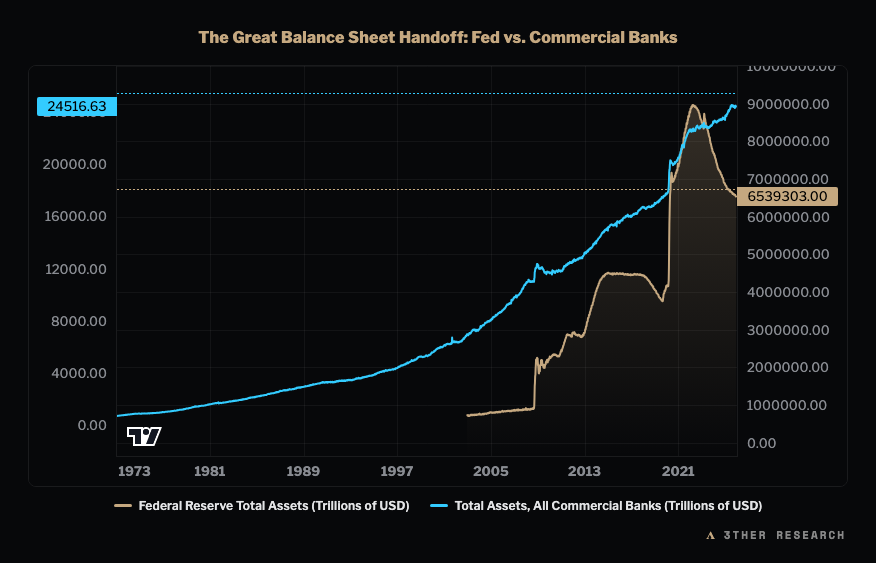
The core of the Warsh Doctrine is a sophisticated three-part maneuver designed to solve two problems at once: the political demand for economic growth and the mathematical reality of an unsustainable national debt. It's a plan to finance the government by proxy, shifting the burden of money creation from the Fed's public balance sheet to the opaque balance sheets of the commercial banking sector.

📈 Step 1: Cut Short-Term Rates. The first move is political and tactical. Warsh was nominated by President Trump with the explicit expectation that he would lower interest rates to stimulate the economy. By cutting the Fed Funds rate, the Fed's target for overnight bank lending, Warsh delivers a "win" for the administration, making short-term borrowing cheaper and providing a tailwind for risk assets. This is the public-facing part of the plan.

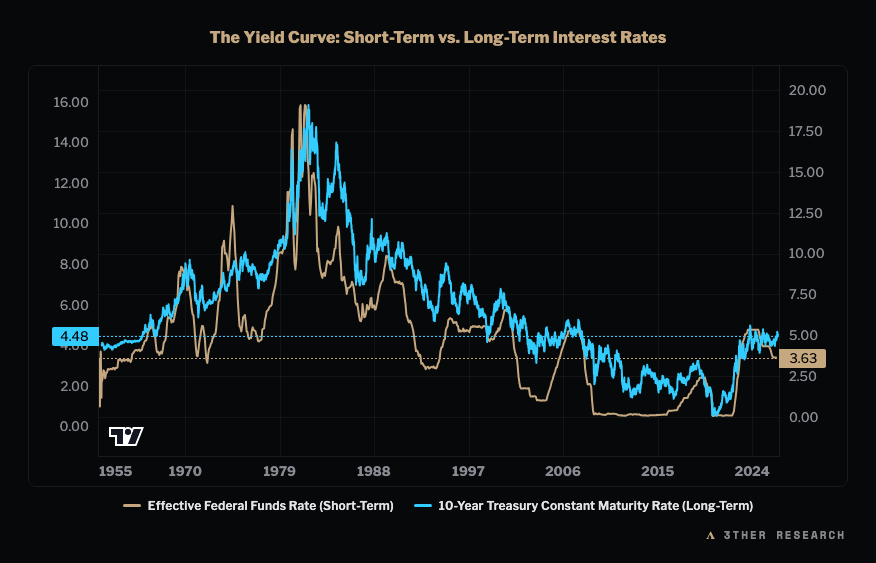
🏦 Step 2: Shrink the Fed's Balance Sheet (Quantitative Tightening). Simultaneously, and counterintuitively, the Fed will continue or even accelerate the reduction of its massive holdings of Treasury bonds. This is Quantitative Tightening (QT). Normally, the Fed selling bonds into the market would push *up* long-term interest rates, tightening financial conditions and hurting the economy. But here, it's an intentional feature, not a bug. The goal is to create a steep yield curve—where long-term interest rates are significantly higher than short-term rates.

🥇 Step 3: Deregulate the Banks. This is the linchpin. For the plan to work, someone has to buy all the bonds the Treasury is issuing and the Fed is selling. The buyers will be the large commercial banks, but they are currently constrained by post-2008 capital requirements, specifically the Supplementary Leverage Ratio (SLR). The SLR forces banks to hold capital against all their assets, including ultra-safe Treasury bonds. The Warsh plan involves permanently exempting Treasuries from the SLR calculation. This regulatory tweak effectively gives banks a green light to buy an almost unlimited amount of government debt.

THE MECHANISM // LAUNDERED QE

With a steep yield curve, banks can borrow money at the very low short-term rates set by the Fed, use that money to buy long-term Treasury bonds yielding a much higher rate, and pocket the difference as risk-free profit. The SLR exemption provides them with the balance sheet capacity to do this at a massive scale. The net effect is identical to the Fed buying the bonds itself (QE), but the accounting is different. The Fed can claim it is tightening by shrinking its balance sheet, while the actual monetary expansion happens quietly on the books of JPMorgan, Bank of America, and others.

The AI Cover Story

Every grand financial plan needs an equally grand narrative to justify it. The intellectual cover for this maneuver is the argument that Artificial Intelligence represents a massive, disinflationary productivity boom. Warsh has explicitly made this case, including in a Wall Street Journal op-ed, arguing that AI will allow the economy to grow faster without triggering inflation, much like the tech boom of the 1990s.

The bottom line: This narrative provides the perfect justification for cutting interest rates even as the government runs huge deficits. The story goes: we don't need to worry about inflation from easy money and fiscal spending because AI is making everything cheaper and more efficient. It allows the Fed to publicly project an image of fighting inflation (via QT) while privately enabling the very policies that would normally cause it.

The First Test: This Week's FOMC Meeting

All eyes are on Warsh's first FOMC meeting, which concludes tomorrow. While no change in the headline interest rate is expected, the language of the statement and the tone of the press conference will be pivotal. Markets are bracing for a hawkish tilt, with the Fed likely to remove language suggesting its next move is a cut and perhaps signal that a hike is possible later this year if inflation remains sticky.

What to watch for:

The great irony is that while the market is focused on the near-term hawk-dove signaling, the real game is a structural rewiring of the financial system. The Warsh Doctrine is a bet that the Fed can engineer a solution to the debt crisis by manipulating bank regulations and winning the narrative war. It's a high-stakes gambit, and it begins now.

Λ3THER Research is an independent financial publisher. All reports are for educational purposes and involve risk. Please review our full Regulatory Disclosures & Risk Warnings.

REGULATORY DISCLOSURE

A3THER Research LLC (“A3THER”) is a financial publisher and research provider. A3THER is not registered as an investment adviser, commodity trading advisor, broker-dealer, or financial planner with the U.S. Securities and Exchange Commission (SEC), the Financial Industry Regulatory Authority (FINRA), or any state or foreign regulatory authority. No content published by A3THER constitutes a recommendation that any particular security, portfolio of securities, transaction, or investment strategy is suitable for any specific person. The information is not tailored to individual circumstances and does not take into account the unique financial situation, investment objectives, or risk tolerance of any recipient. Nothing contained herein establishes a fiduciary, advisory, or client relationship between the reader and A3THER.

INVESTMENT RISK WARNING

All financial markets involve substantial risk, including the complete loss of principal. Highly volatile asset classes—including equities, sovereign bonds, commodities, foreign exchange, and digital assets—can experience sharp fluctuations. The research, opinions, analyses, projections, and reports published by A3THER are for general educational, historical, and informational purposes only. Readers must conduct their own independent due diligence and consult with a licensed financial adviser, tax professional, and legal counsel before making any investment decisions. Under no circumstances shall A3THER, its members, officers, or contributors be liable for any direct, indirect, incidental, special, or consequential trading losses or damages incurred as a result of relying on any data, models, charts, analysis, or strategic reviews published herein.

PROPRIETARY DATA & PROJECTIONS

Historical calculations, dual-axis charts, correlation matrices, and yield projections are synthesized using public APIs, scraping engines, and proprietary quantitative models. All charts and historical figures are for illustrative and conceptual purposes only. Hypothetical or backtested performance has inherent limitations, is not reflective of actual trading, and does not guarantee future results. Information is provided on an "as is" basis, without express or implied warranties of any kind regarding accuracy, completeness, timeliness, or reliability.

PRIVACY POLICY

At A3THER Research, we prioritize the privacy and security of our institutional clients and subscribers. We collect minimal personal data, restricted to registration emails and session preferences required to operate our analytical platform. Your email address is exclusively utilized for dispatching research updates and will never be shared, sold, or distributed to third parties. We leverage industry-standard cryptographic protocols to protect all stored information. If you wish to purge your subscription data or request details on collected metrics, please contact operations@a3ther.research.

TERMS OF SERVICE

By accessing the A3THER Research Portal or subscribing to our daily briefs, you agree to comply with and be bound by these Terms of Service. All content, analytical tools, models, and projections are the intellectual property of A3THER Research LLC and are licensed for personal, non-redistributable use. Redistribution, replication, or commercial exploitation of A3THER reports is strictly prohibited without prior written authorization. The services are provided "as is" and "as available" without warranties of any kind. We reserve the right to suspend subscription access or terminate user privileges at our discretion for violations of intellectual property guidelines.

FORM ADV PART II (SUMMARY)

By accessing the A3THER Research Portal, you acknowledge that A3THER Research LLC is not a registered investment adviser (RIA) and does not file a Form ADV with the SEC or state regulators. This portal provides research and publishing services exclusively. For entities requiring regulatory disclosure packets or operational due diligence (ODD) questionnaires, A3THER maintains an institutional fact sheet outlining its operations, data sources, and analytical methodologies. To request the institutional factsheet, please submit an inquiry through your family office or institutional representative to legal@a3ther.research.