Λ

Λ3THER RESEARCH BRIEF

The Great Unraveling: China's Golden Gambit

July 01, 2026

As Western markets fixate on the Federal Reserve's every word, a tectonic shift in the global monetary order is accelerating in the East, with China moving to dismantle the paper gold market and challenge the very foundation of the dollar system.

EXECUTIVE THESIS // TACTICAL VIEW

The global financial system is quietly bifurcating. While the West remains trapped in a sovereign debt spiral, managed by central bank rhetoric, the East is executing a strategic pivot toward hard assets. China's systematic shutdown of retail "paper gold" trading is not about protecting investors; it's a calculated move to eliminate speculative price suppression and force a repricing of physical gold, establishing a new monetary anchor outside the dollar's orbit. This creates a profound divergence between paper assets, which are losing purchasing power, and real assets, which are being systematically accumulated by sovereign powers. The key trigger to watch is the widening spread between physical gold prices in Shanghai and paper contract prices in London and New York.

While Wall Street spent the day parsing every syllable from new Federal Reserve Chair Kevin Warsh's remarks in Portugal, the truly seismic event in macroeconomics is happening thousands of miles away, and it has nothing to do with interest rate guidance. Markets today are reacting to Warsh's hawkish tone, with stocks dipping and the dollar climbing as traders recalibrate for a Fed less inclined to offer forward guidance. But this is a distraction—a battle over the weather when the climate itself is changing.

The real story is the structural unraveling of the post-1971 monetary system. In the West, we see the symptoms: a stock market whose nominal highs mask a rapid decline in the dollar's purchasing power, a flood of capital fleeing US assets, and a political landscape increasingly defined by trade disputes, evidenced by today's decision not to renew the USMCA trade pact for a full 16-year term. In the East, we see the strategy: a quiet, systematic dismantling of the West's primary tool for monetary control—the paper derivatives market for gold.

1. The Paper Gold Charade

Why it matters: The price of gold you see on your screen is not the price of physical gold. It is the price of a paper claim on gold, and there are vastly more claims in existence than there is physical metal to back them. This is the bedrock of the modern financial system, and it's beginning to crack.

Think of it like a coat check at an exclusive event. You hand over your one-of-a-kind coat and receive a paper ticket. The system works perfectly as long as there is one ticket for one coat. But what if the attendant, realizing most people never bother to pick up their coats, starts printing and selling hundreds of identical tickets? The perceived supply of coats explodes, and the value of any single ticket plummets. On paper, the coats are plentiful and cheap. In reality, there is still only one coat.

This is, in essence, the structure of the Western gold markets in London and New York. The vast majority of daily trading is in futures contracts and other derivatives—paper claims that are rarely settled for physical delivery. This creates a massive artificial supply, which for decades has acted as a powerful mechanism to suppress the price of real gold. A low gold price is essential for maintaining confidence in fiat currencies like the dollar. If gold were to reflect the true scale of global debt and money printing, the illusion of currency stability would shatter.

2. China's Golden Checkmate

The big picture: China is systematically calling the West's bluff. Over the past year, major Chinese banks, one after another, have shut down access to paper gold trading for their retail customers. The official reason given is to protect citizens from "volatility." The real reason is to drain the swamp of paper speculation and force price discovery to occur in the physical market, where China is now the dominant player.

By eliminating the ability to gamble on the price of gold with leverage, China is channeling demand directly into physical metal. This move coincides with two other critical trends:

This is not a speculative bet. It is a deliberate, long-term strategy to de-dollarize and establish a new monetary order anchored by a neutral reserve asset that cannot be sanctioned or printed—physical gold.

3. The West's Paper Prison

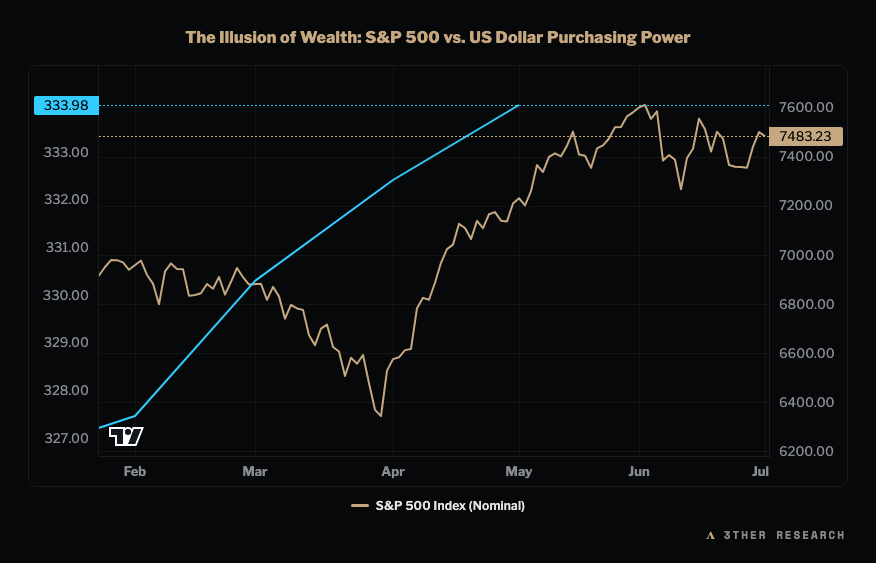
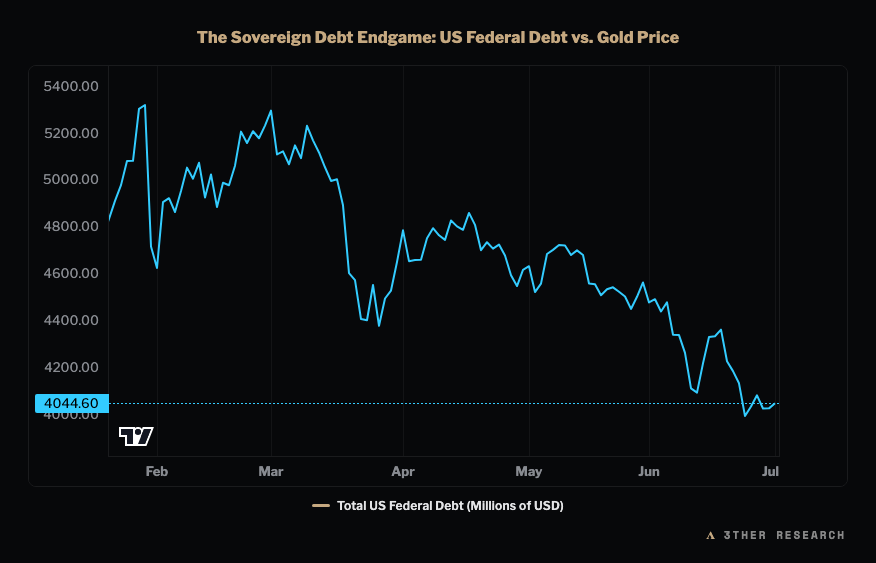
Zoom in: This strategic move by the East exposes the profound fragility of the American economic model. The U.S. is caught in a sovereign debt trap. With federal debt spiraling, the only viable path forward is to devalue the currency to inflate away the debt burden. This is why the S&P 500 can hit new nominal highs while real, inflation-adjusted corporate profits have been stagnant since 2021.

Investors are chasing numbers on a screen, measured in a unit of account that is itself losing value at an accelerating pace. The rising stock market is not a sign of economic health; it is a fever chart of currency debasement. This creates a dangerous illusion of wealth that masks the underlying erosion of purchasing power.

THE DIVERGENCE

The core conflict is now between paper and physical. The West's financial system is built on ever-expanding layers of paper claims (stocks, bonds, derivatives) denominated in a fiat currency. The East is moving to re-anchor the system to a physical asset with finite supply. As China removes the paper market's ability to suppress gold's price, the true cost of the West's debt burden will be revealed.

This dynamic is precisely why markets are so sensitive to Fed Chair Warsh. His hawkish stance and refusal to provide forward guidance signals an end to the era of explicit central bank support. He stated plainly today, "If anyone thought we'd be happy with inflation above 2%, they will be disappointed." This puts the Fed in direct conflict with the government's need for currency devaluation. A hawkish Fed tightens financial conditions, threatening the very paper assets that have been levitated by loose policy, while doing little to solve the underlying sovereign debt crisis.

4. The Road Ahead: Fragmentation and Real Assets

What's next: The global economy is fragmenting. Today's decision by the Trump administration to put the USMCA on a "short leash" of annual reviews instead of a long-term renewal is another sign that the era of stable, predictable globalization is over. Nations are prioritizing strategic interests over open trade, creating a more uncertain and volatile geopolitical landscape.

In this environment, the game is no longer about maximizing nominal returns in a unified system. It is about preserving purchasing power in a fracturing one.

The great unraveling continues until one of two things happens: Either the West finds a way to restructure its monumental debt without a catastrophic currency crisis, or the East successfully forces a repricing of real assets against paper claims. China's actions in the gold market suggest they are betting heavily on the latter. The world is waking up to the fact that the coat check attendant has been selling phantom tickets for fifty years, and they are all lining up at once to demand their coats back.

Λ3THER Research is an independent financial publisher. All reports are for educational purposes and involve risk. Please review our full Regulatory Disclosures & Risk Warnings.

REGULATORY DISCLOSURE

A3THER Research LLC (“A3THER”) is a financial publisher and research provider. A3THER is not registered as an investment adviser, commodity trading advisor, broker-dealer, or financial planner with the U.S. Securities and Exchange Commission (SEC), the Financial Industry Regulatory Authority (FINRA), or any state or foreign regulatory authority. No content published by A3THER constitutes a recommendation that any particular security, portfolio of securities, transaction, or investment strategy is suitable for any specific person. The information is not tailored to individual circumstances and does not take into account the unique financial situation, investment objectives, or risk tolerance of any recipient. Nothing contained herein establishes a fiduciary, advisory, or client relationship between the reader and A3THER.

INVESTMENT RISK WARNING

All financial markets involve substantial risk, including the complete loss of principal. Highly volatile asset classes—including equities, sovereign bonds, commodities, foreign exchange, and digital assets—can experience sharp fluctuations. The research, opinions, analyses, projections, and reports published by A3THER are for general educational, historical, and informational purposes only. Readers must conduct their own independent due diligence and consult with a licensed financial adviser, tax professional, and legal counsel before making any investment decisions. Under no circumstances shall A3THER, its members, officers, or contributors be liable for any direct, indirect, incidental, special, or consequential trading losses or damages incurred as a result of relying on any data, models, charts, analysis, or strategic reviews published herein.

PROPRIETARY DATA & PROJECTIONS

Historical calculations, dual-axis charts, correlation matrices, and yield projections are synthesized using public APIs, scraping engines, and proprietary quantitative models. All charts and historical figures are for illustrative and conceptual purposes only. Hypothetical or backtested performance has inherent limitations, is not reflective of actual trading, and does not guarantee future results. Information is provided on an "as is" basis, without express or implied warranties of any kind regarding accuracy, completeness, timeliness, or reliability.

PRIVACY POLICY

At A3THER Research, we prioritize the privacy and security of our institutional clients and subscribers. We collect minimal personal data, restricted to registration emails and session preferences required to operate our analytical platform. Your email address is exclusively utilized for dispatching research updates and will never be shared, sold, or distributed to third parties. We leverage industry-standard cryptographic protocols to protect all stored information. If you wish to purge your subscription data or request details on collected metrics, please contact operations@a3ther.research.

TERMS OF SERVICE

By accessing the A3THER Research Portal or subscribing to our daily briefs, you agree to comply with and be bound by these Terms of Service. All content, analytical tools, models, and projections are the intellectual property of A3THER Research LLC and are licensed for personal, non-redistributable use. Redistribution, replication, or commercial exploitation of A3THER reports is strictly prohibited without prior written authorization. The services are provided "as is" and "as available" without warranties of any kind. We reserve the right to suspend subscription access or terminate user privileges at our discretion for violations of intellectual property guidelines.

FORM ADV PART II (SUMMARY)

By accessing the A3THER Research Portal, you acknowledge that A3THER Research LLC is not a registered investment adviser (RIA) and does not file a Form ADV with the SEC or state regulators. This portal provides research and publishing services exclusively. For entities requiring regulatory disclosure packets or operational due diligence (ODD) questionnaires, A3THER maintains an institutional fact sheet outlining its operations, data sources, and analytical methodologies. To request the institutional factsheet, please submit an inquiry through your family office or institutional representative to legal@a3ther.research.