Λ

Λ3THER RESEARCH BRIEF

The Global Bond Market's Reckoning: Oil Relief Masks Deeper Debt Distress

May 27, 2026

As geopolitical tensions ease and crude prices fall, the underlying sovereign debt crisis continues to tighten its grip on global markets, forcing central banks into an impossible trap while equity markets remain in a speculative frenzy.

EXECUTIVE THESIS // TACTICAL VIEW

Global bond markets are flashing warning signs as yields hit multi-decade highs. While easing tensions in the Middle East have temporarily cooled down oil prices and inflation fears, the underlying problem of massive government debt remains unresolved. Central banks are trapped: raising rates further to fight inflation could break the bond market, while lowering rates would destroy trust in government finances. This structural instability is creating a massive gap between a struggling real economy and pockets of speculative stock market euphoria.

👋 1 big thing: Oil Tumbles, But the Debt Trap Remains

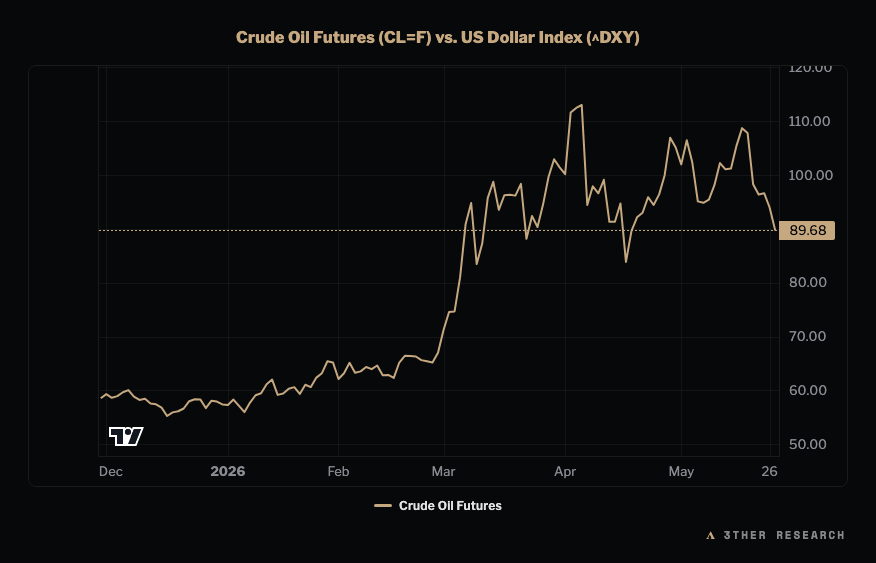
Oil prices fell sharply today on news of a potential peace deal in the Middle East and the reopening of the Strait of Hormuz. Brent crude dropped below $95 a barrel, and US crude fell below $90. This immediately eased concerns about energy inflation, causing government bond yields to pull back slightly.

The big picture: While cheaper oil offers temporary relief, it does not fix the deeper, structural issue of rising global government debt. The market's focus is quickly shifting from temporary geopolitical risks to the permanent fiscal problems plaguing major economies.

Why it matters: The Bond Market's Breaking Point

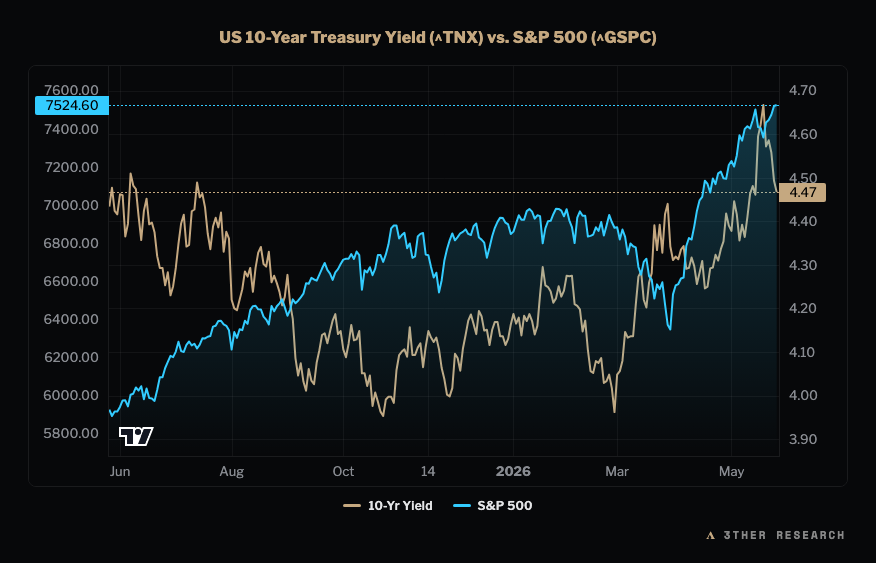
The bond market is the foundation of the global financial system, and right now, it is signaling severe distress. The US 30-year government bond yield recently hit its highest level in 19 years, climbing past 5.14%, and the 10-year yield has also jumped. This is not just a US problem—Japan's 10-year bond yield hit a 30-year high, and its 30-year yield reached its highest level since 1999. We are seeing multi-decade highs in bond yields across the UK, Germany, France, Canada, and Australia.

The implication: Investors are demanding interest rates because they are losing trust in governments' ability to repay their massive debts, especially as persistent inflation eats away at the value of future payments. This loss of trust is clear: major foreign buyers like Taiwan, Saudi Arabia, India, the UAE, Norway, and Singapore are actively selling off US government debt. Meanwhile, Europe's financial vulnerabilities are growing as they deal with the economic fallout of recent energy disruptions.

Zoom in: The Fed's Impossible Trap

The Federal Reserve is in a corner. Fed officials have indicated they are ready to raise interest rates again if inflation stays high. Markets are now pricing in a high chance of another rate hike by January 2027—a major shift from earlier hopes of rate cuts.

The dilemma: The Fed cannot easily lower rates because doing so could cause the bond market to collapse. A bond crash would spike mortgage rates, drive up credit card interest, and threaten the government's ability to fund key programs like Social Security and Medicare. However, keeping rates high or raising them further makes it much harder to pay the interest on the US national debt, which has now crossed $39 trillion. In fact, annual interest payments are quickly approaching a point where they could consume all federal tax revenues.

This trap is locked in by persistent inflation, with wholesale prices rising at 6% and consumer prices at 3.8%—both far above the Fed's 2% target. The old playbook of central bank interventions is no longer working in this new economic environment.

The other side of the coin: Pockets of Euphoria

In stark contrast to the struggling bond market, stock markets are showing wild excitement, especially in artificial intelligence. Micron Technology recently became the latest tech company to cross a $1 trillion valuation, with its stock price more than tripling in 2026. South Korea's SK Hynix also crossed the trillion-dollar mark, and Samsung shares surged. The hype around the SpaceX IPO is also boosting rocket and satellite companies.

Why it matters: This split happens because capital is searching for high returns in a system plagued by inflation and poor options. Even as the broader economy shows signs of stress, select tech and defense sectors benefit from massive innovation and speculative investment. At the same time, giants like JPMorgan Chase are searching for massive $20 billion acquisitions, positioned to absorb smaller players as the environment toughens.

The bottom line: A Global Financial Reset Underway

All of these signs point to a major shift: the traditional economic model is breaking down. The classic investing strategy of using government bonds to hedge against stock market risk is failing, as both bonds and stocks have crashed together in recent volatility.

This is not just a normal downturn; it is a fundamental re-evaluation of government debt risk worldwide. We have shifted from a world of too little demand to a world of structural supply shortages. We are at a critical junction: either governments find a way to manage their massive budgets and curb inflation expectations, or central banks will have to choose between a government debt default and printing money to inflate the debt away. The latter choice would trigger a massive financial reset with unpredictable consequences for all global assets.

A3THER Research is an independent financial publisher. All reports are for educational purposes and involve risk. Please review our full Regulatory Disclosures & Risk Warnings.

REGULATORY DISCLOSURE

A3THER Research LLC (“A3THER”) is a financial publisher and research provider. A3THER is not registered as an investment adviser, commodity trading advisor, broker-dealer, or financial planner with the U.S. Securities and Exchange Commission (SEC), the Financial Industry Regulatory Authority (FINRA), or any state or foreign regulatory authority. No content published by A3THER constitutes a recommendation that any particular security, portfolio of securities, transaction, or investment strategy is suitable for any specific person. The information is not tailored to individual circumstances and does not take into account the unique financial situation, investment objectives, or risk tolerance of any recipient. Nothing contained herein establishes a fiduciary, advisory, or client relationship between the reader and A3THER.

INVESTMENT RISK WARNING

All financial markets involve substantial risk, including the complete loss of principal. Highly volatile asset classes—including equities, sovereign bonds, commodities, foreign exchange, and digital assets—can experience sharp fluctuations. The research, opinions, analyses, projections, and reports published by A3THER are for general educational, historical, and informational purposes only. Readers must conduct their own independent due diligence and consult with a licensed financial adviser, tax professional, and legal counsel before making any investment decisions. Under no circumstances shall A3THER, its members, officers, or contributors be liable for any direct, indirect, incidental, special, or consequential trading losses or damages incurred as a result of relying on any data, models, charts, analysis, or strategic reviews published herein.

PROPRIETARY DATA & PROJECTIONS

Historical calculations, dual-axis charts, correlation matrices, and yield projections are synthesized using public APIs, scraping engines, and proprietary quantitative models. All charts and historical figures are for illustrative and conceptual purposes only. Hypothetical or backtested performance has inherent limitations, is not reflective of actual trading, and does not guarantee future results. Information is provided on an "as is" basis, without express or implied warranties of any kind regarding accuracy, completeness, timeliness, or reliability.

PRIVACY POLICY

At A3THER Research, we prioritize the privacy and security of our institutional clients and subscribers. We collect minimal personal data, restricted to registration emails and session preferences required to operate our analytical platform. Your email address is exclusively utilized for dispatching research updates and will never be shared, sold, or distributed to third parties. We leverage industry-standard cryptographic protocols to protect all stored information. If you wish to purge your subscription data or request details on collected metrics, please contact operations@a3ther.research.

TERMS OF SERVICE

By accessing the A3THER Research Portal or subscribing to our daily briefs, you agree to comply with and be bound by these Terms of Service. All content, analytical tools, models, and projections are the intellectual property of A3THER Research LLC and are licensed for personal, non-redistributable use. Redistribution, replication, or commercial exploitation of A3THER reports is strictly prohibited without prior written authorization. The services are provided "as is" and "as available" without warranties of any kind. We reserve the right to suspend subscription access or terminate user privileges at our discretion for violations of intellectual property guidelines.

FORM ADV PART II (SUMMARY)

By accessing the A3THER Research Portal, you acknowledge that A3THER Research LLC is not a registered investment adviser (RIA) and does not file a Form ADV with the SEC or state regulators. This portal provides research and publishing services exclusively. For entities requiring regulatory disclosure packets or operational due diligence (ODD) questionnaires, A3THER maintains an institutional fact sheet outlining its operations, data sources, and analytical methodologies. To request the institutional factsheet, please submit an inquiry through your family office or institutional representative to legal@a3ther.research.