Λ

Λ3THER RESEARCH BRIEF

The Dollar's Abdication

August 07, 2026

A shocking jobs report miss isn't just about the Fed; it's the catalyst forcing the U.S. to sacrifice the dollar's strength to prevent a global financial meltdown.

EXECUTIVE THESIS // TACTICAL VIEW

This morning's stunning loss of 23,000 jobs has shattered the narrative of a resilient U.S. labor market, acting as the trigger event for a major policy regime shift. Faced with an impossible trilemma—the conflicting needs to reshore industry, maintain price stability, and ensure economic growth—Washington is being forced to abandon dollar supremacy. The recent, unprecedented joint intervention to support the Japanese yen was the opening salvo; today's weak data provides the political cover to accelerate this pivot. The tactical view is a weaker dollar, higher commodity prices, and extreme volatility as the world reprices risk without its traditional anchor.

1. The Jobs Report That Broke the Machine

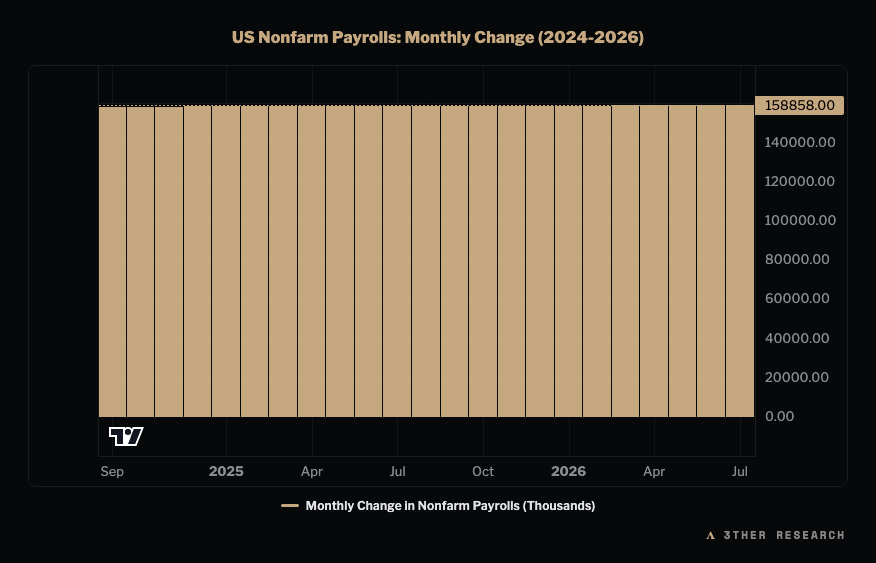
The consensus was wrong. Dangerously wrong. This morning, the Bureau of Labor Statistics reported that the U.S. economy unexpectedly shed 23,000 jobs in July, a stark reversal from the 80,000 gain that economists had forecasted. To compound the shock, payroll numbers for May and June were revised down by a combined 103,000, revealing a far deeper weakness than previously understood.

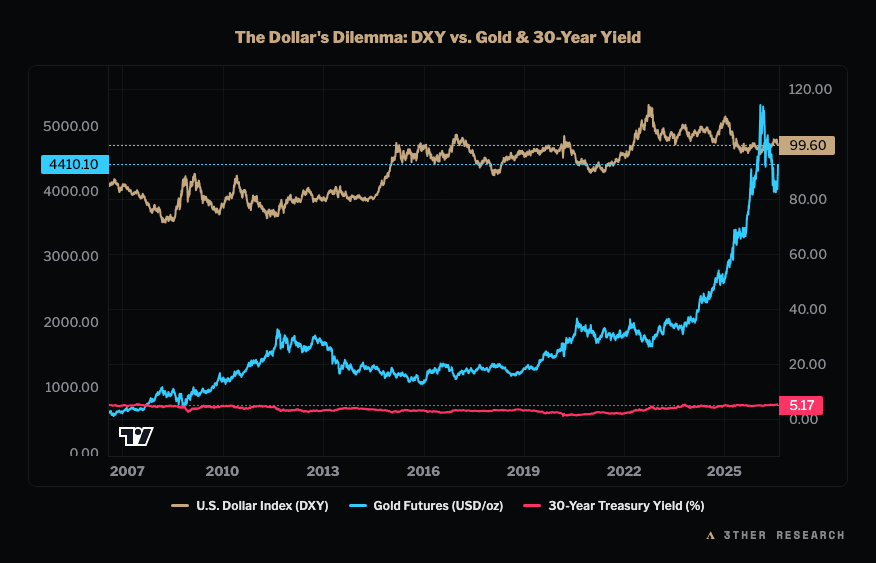
👋 1 big thing: The market's immediate reaction was a textbook "bad news is good news" rally. Stock futures jumped, and the odds of a Fed rate hike in September plummeted as traders priced in a more dovish central bank. The U.S. Dollar Index (DXY) fell sharply, while bonds and precious metals like gold and silver surged.

Why it matters: This knee-jerk reaction misses the tectonic shift occurring beneath the surface. The jobs report is not merely a data point for the Federal Reserve; it is the breaking point for U.S. economic policy. It exposes the deep fragility of the real economy, a reality that has been masked by soaring asset prices and a relentless AI investment boom.

The divergence between a struggling consumer and a euphoric stock market has reached a breaking point. As noted in recent research, consumer confidence has been plumbing historic lows even as stock market optimism hit dot-com bubble levels. This jobs report is the first official confirmation that the real economy is finally cracking under the strain.

2. The Impossible Trilemma

To understand the gravity of the situation, one must look beyond the monthly jobs number and see the strategic trap the United States has walked into. With national debt crossing $40 trillion, the country is facing an impossible policy trilemma.

The U.S. is desperately trying to achieve three conflicting goals simultaneously:

The bottom line: You can't have all three. A strong dollar kills reshoring and risks market stability. A weak dollar fuels inflation. For years, the U.S. has tried to walk this tightrope, but the rope has just snapped. The jobs report signals that the "strong dollar" policy is now actively damaging the domestic economy, forcing a choice.

3. The Yen Intervention: A Shot Across the Bow

The first clear evidence of this choice came not from the jobs report, but a week prior. In a move that hasn't been seen in decades, the U.S. Treasury, alongside the Bank of Japan, directly intervened in currency markets to prop up the collapsing Japanese yen.

Zoom in: On the surface, this was framed as helping an ally. President Trump stated, "we're always there for Japan." But the underlying driver was pure self-interest. A free-falling yen would have forced Japan, one of the largest foreign holders of U.S. debt, to sell its Treasury holdings to defend its currency.

Such a "fire sale" of U.S. bonds would have sent American interest rates soaring, potentially crashing the housing market, crippling corporate borrowing, and popping the AI-fueled stock market bubble.

The big picture: The intervention was a preemptive strike to protect the U.S. bond market. It was an admission that the U.S. financial system is too fragile to withstand the consequences of its own "strong dollar" policy. By choosing to actively sell dollars (via euros) to buy yen, Treasury Secretary Scott Bessent signaled a profound policy shift: the stability of the global financial system now takes precedence over maintaining the dollar's absolute strength. Today's jobs report provides the perfect domestic justification to continue and expand this policy.

4. Geopolitical Tinderbox & The New Power Axis

This shift away from dollar dominance is not happening in a vacuum. The geopolitical landscape is becoming increasingly fraught, with the conflict with Iran threatening to boil over and a new power bloc forming in the Middle East.

What's happening: As President Trump weighs a "massive attack" on Iran to force a resolution, a new defense pact was signed today between Saudi Arabia, Turkey, and Pakistan. This is a landmark agreement creating a Sunni security axis that hedges against both Iranian aggression and perceived U.S. unreliability.

Why it's a game-changer: This pact signals that regional powers are no longer waiting for Washington's direction. They are building parallel security structures, diversifying away from the U.S. security umbrella that has underpinned the petrodollar system for 50 years. An economically weakened America, forced to devalue its currency, is seen as a less reliable long-term partner.

Any escalation in the Strait of Hormuz would now have far more complex ripple effects, potentially triggering this new defense pact and causing an energy shock that the Fed, constrained by a weak labor market, would be powerless to fight with higher rates.

5. The Road Ahead: A Managed Demolition

The path forward is one of managed decline. The U.S. will likely continue to orchestrate a weaker dollar, not out of choice, but out of necessity. This solves the trilemma by sacrificing price stability to save the other two pillars.

The final word: The era of unquestioned U.S. dollar supremacy is over. It is not being ended by a rival power, but by the internal contradictions of America's own debt and policy choices. The shocking July jobs report was the final straw. Investors must now navigate a world where the primary safe haven is being deliberately devalued by its own issuer. The key metric to watch is no longer the Fed funds rate, but the long-term Treasury yield—it will be the ultimate arbiter of whether this controlled demolition of the dollar remains controlled, or spirals into a sovereign debt crisis.

Λ3THER Research is an independent financial publisher. All reports are for educational purposes and involve risk. Please review our full Regulatory Disclosures & Risk Warnings.

REGULATORY DISCLOSURE

A3THER Research LLC (“A3THER”) is a financial publisher and research provider. A3THER is not registered as an investment adviser, commodity trading advisor, broker-dealer, or financial planner with the U.S. Securities and Exchange Commission (SEC), the Financial Industry Regulatory Authority (FINRA), or any state or foreign regulatory authority. No content published by A3THER constitutes a recommendation that any particular security, portfolio of securities, transaction, or investment strategy is suitable for any specific person. The information is not tailored to individual circumstances and does not take into account the unique financial situation, investment objectives, or risk tolerance of any recipient. Nothing contained herein establishes a fiduciary, advisory, or client relationship between the reader and A3THER.

INVESTMENT RISK WARNING

All financial markets involve substantial risk, including the complete loss of principal. Highly volatile asset classes—including equities, sovereign bonds, commodities, foreign exchange, and digital assets—can experience sharp fluctuations. The research, opinions, analyses, projections, and reports published by A3THER are for general educational, historical, and informational purposes only. Readers must conduct their own independent due diligence and consult with a licensed financial adviser, tax professional, and legal counsel before making any investment decisions. Under no circumstances shall A3THER, its members, officers, or contributors be liable for any direct, indirect, incidental, special, or consequential trading losses or damages incurred as a result of relying on any data, models, charts, analysis, or strategic reviews published herein.

PROPRIETARY DATA & PROJECTIONS

Historical calculations, dual-axis charts, correlation matrices, and yield projections are synthesized using public APIs, scraping engines, and proprietary quantitative models. All charts and historical figures are for illustrative and conceptual purposes only. Hypothetical or backtested performance has inherent limitations, is not reflective of actual trading, and does not guarantee future results. Information is provided on an "as is" basis, without express or implied warranties of any kind regarding accuracy, completeness, timeliness, or reliability.

PRIVACY POLICY

At A3THER Research, we prioritize the privacy and security of our institutional clients and subscribers. We collect minimal personal data, restricted to registration emails and session preferences required to operate our analytical platform. Your email address is exclusively utilized for dispatching research updates and will never be shared, sold, or distributed to third parties. We leverage industry-standard cryptographic protocols to protect all stored information. If you wish to purge your subscription data or request details on collected metrics, please contact operations@a3ther.research.

TERMS OF SERVICE

By accessing the A3THER Research Portal or subscribing to our daily briefs, you agree to comply with and be bound by these Terms of Service. All content, analytical tools, models, and projections are the intellectual property of A3THER Research LLC and are licensed for personal, non-redistributable use. Redistribution, replication, or commercial exploitation of A3THER reports is strictly prohibited without prior written authorization. The services are provided "as is" and "as available" without warranties of any kind. We reserve the right to suspend subscription access or terminate user privileges at our discretion for violations of intellectual property guidelines.

FORM ADV PART II (SUMMARY)

By accessing the A3THER Research Portal, you acknowledge that A3THER Research LLC is not a registered investment adviser (RIA) and does not file a Form ADV with the SEC or state regulators. This portal provides research and publishing services exclusively. For entities requiring regulatory disclosure packets or operational due diligence (ODD) questionnaires, A3THER maintains an institutional fact sheet outlining its operations, data sources, and analytical methodologies. To request the institutional factsheet, please submit an inquiry through your family office or institutional representative to legal@a3ther.research.