Λ3THER RESEARCH BRIEF
The Unraveling of the Dollar Monopoly
June 10, 2026
A system designed in 1944 to ensure stability is now the epicenter of global financial fragmentation, as decades of weaponization force the world to build an escape route.
EXECUTIVE THESIS // TACTICAL VIEW
The dollar's dominance was never a law of nature, but a series of strategic agreements built for a post-war world. The 2022 freezing of Russia's reserves was a catalyst, accelerating a multi-decade trend of de-dollarization from a theoretical risk into an urgent sovereign priority. Now, as central banks hoard physical gold at record rates and BRICS nations build parallel payment rails, the U.S. faces a structural crisis: it must fund record deficits at the precise moment its most reliable foreign creditors are seeking an exit. This is not a sudden collapse, but a slow, calculated fragmentation of the global monetary order.
The global financial system operates on a bedrock of trust. For over 80 years, that trust has been denominated in U.S. dollars. But the architecture of that system, forged in the final days of World War II, was designed for a world that no longer exists. The geopolitical and economic realities of 2026 are exposing deep fractures in this foundation. The very tools that cemented the dollar's power—its role in energy markets and its integration into global clearing systems—have been weaponized, forcing nations to question the safety of the world's reserve currency. What we are witnessing is not a cyclical market trend, but a structural shift in the tectonic plates of global finance.
1. The Setup (1944): The Bretton Woods Monopoly
The big picture: In July 1944, with the end of WWII in sight, delegates from 44 Allied nations gathered in Bretton Woods, New Hampshire, to design a new global economic order. Their goal was to avoid the chaotic currency devaluations and trade protectionism that had crippled the global economy in the 1930s and contributed to the war.
How it worked: The agreement established a system of fixed exchange rates. Every major currency was pegged to the U.S. dollar, and the U.S. dollar, in turn, was pegged to gold at a fixed rate of $35 per ounce. This effectively made the dollar the world's reserve currency, the anchor of the entire system. The U.S., holding two-thirds of the world's gold reserves at the time, was the only country that could guarantee this convertibility.
The enforcers: To manage this new order, two powerful institutions were created:
- 🏦 The International Monetary Fund (IMF): Tasked with overseeing the system of fixed exchange rates and providing short-term loans to countries facing balance-of-payments problems to prevent them from devaluing their currencies.
- 🏦 The World Bank (IBRD): Created to provide financial assistance for the reconstruction of war-torn nations and the development of poorer countries.
This arrangement placed the U.S. dollar at the absolute center of global commerce and finance, a privileged position that would define the next half-century.
2. The Pivot (1971–1974): Birth of the Petrodollar
Why it matters: The Bretton Woods system contained a fatal flaw, known as the Triffin dilemma. As the global economy grew, it needed more dollars for liquidity, but the U.S. gold supply was finite. By the late 1960s, massive spending on the Vietnam War and domestic social programs meant the U.S. had printed far more dollars than it could back with gold.
The Nixon Shock: Nations like France grew nervous and began demanding gold for their dollar reserves. Facing a potential run on its gold, President Richard Nixon made a stunning move on August 15, 1971. He unilaterally suspended the direct convertibility of the U.S. dollar to gold. This act, known as the "Nixon Shock," effectively ended the Bretton Woods system and turned the dollar into a fiat currency, backed only by the "full faith and credit" of the U.S. government.
The Saudi Deal: The dollar's anchor was gone, creating a vacuum. Washington needed a new reason for the world to demand its currency. They found it in oil. In a series of quiet negotiations culminating in 1974, the U.S. struck a pivotal, informal agreement with Saudi Arabia.
- The terms: The U.S. would provide military aid and security guarantees to the Kingdom. In exchange, Saudi Arabia would price all of its oil exports exclusively in U.S. dollars and persuade other OPEC nations to do the same.
- The Debt Loop: Crucially, the Saudis agreed to invest their vast oil profits—the "petrodollars"—back into U.S. Treasury bonds. This created a perfect recycling mechanism: nations had to buy dollars to purchase oil, and the oil producers then used those dollars to finance America's growing deficits. This system ensured a constant global demand for both the dollar and U.S. debt.
3. The Fracture: Weaponizing the Currency
The catalyst: For decades, the dollar's central role in global clearing systems like SWIFT was seen as a public utility. That perception shattered in 2022. Following the invasion of Ukraine, the U.S. and its allies took the unprecedented step of freezing roughly $300 billion of the Russian central bank's foreign currency reserves.
Why it's a game-changer: This "weaponization of finance" sent a shockwave through the non-Western world. It was a clear signal that dollar-denominated assets, once considered the safest in the world, could be seized. For any nation with a foreign policy that might diverge from Washington's, holding vast dollar reserves suddenly looked less like a sign of stability and more like a critical vulnerability.
Bypassing the system: The response has been a quiet but determined effort to build an alternative financial architecture.
- 📈 BRICS Pay: The BRICS nations (Brazil, Russia, India, China, South Africa, and new members) are accelerating plans for "BRICS Pay," a platform to integrate their national payment systems. The goal, expected to see implementation in 2026, is to facilitate direct trade in local currencies, bypassing the dollar and SWIFT entirely.
- 📈 Bilateral Trade: Trade settled in local currencies is surging. Over 80% of trade between Russia and China is now conducted in rubles and yuan. China now settles about a third of its foreign trade in its own currency, up from 20% in 2022. These are no longer fringe activities; they are state policy.
4. The 2026 Reality: The Flight to Gold
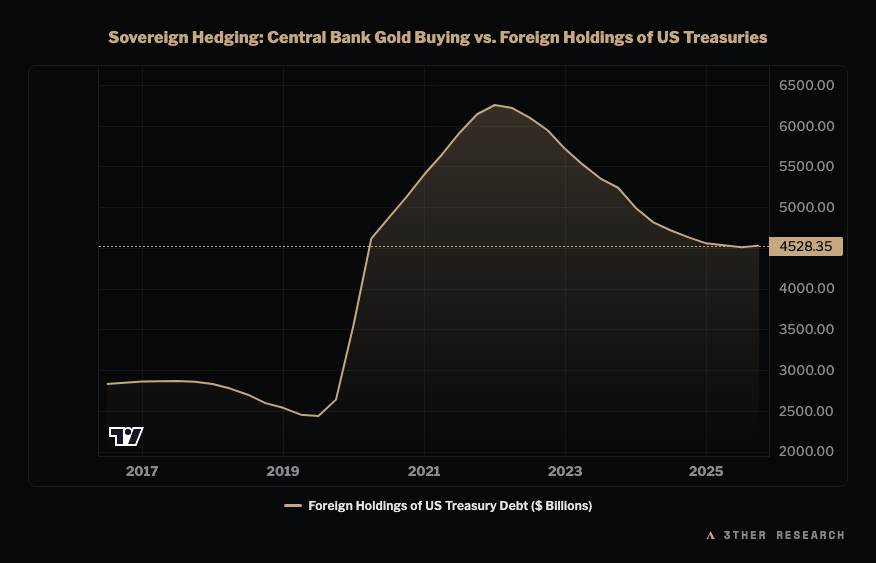
Zoom in: The strategic response to the weaponization of the dollar is most visible in the physical gold market. Central banks, particularly in the emerging world, are aggressively hoarding gold as a neutral reserve asset that exists outside any single nation's control.
The Sovereign Gold Rush: Since 2022, central bank gold buying has more than doubled its historical average. Purchases in 2025 were around 850 tonnes, and projections for 2026 remain robust at around 800 tonnes. The People's Bank of China has now increased its gold reserves for 19 consecutive months. This is not speculative buying; it is a long-term portfolio diversification away from dollar-denominated assets. A 2025 survey showed 95% of central banks expect global gold reserves to increase.
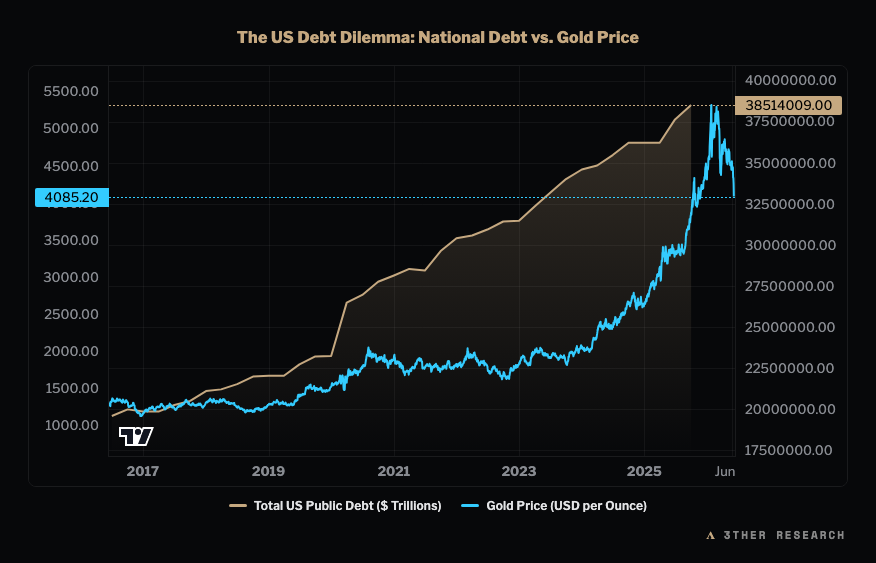
The Treasury Problem: This shift is happening at the worst possible time for the U.S. Treasury. To fund persistent and massive fiscal deficits, the U.S. is flooding the market with new debt. However, the traditional buyers of that debt—foreign central banks—are now diversifying. While recent data from June 2026 shows foreign demand has steadied for now, the long-term trend is clear: demand is becoming more price-sensitive. The U.S. may need to offer higher yields to attract buyers, increasing its own borrowing costs and creating a dangerous feedback loop.
5. The Conclusion: The "Cleanest Dirty Shirt"
The bottom line: Despite these deep structural cracks, the dollar has not collapsed. The reason is simple: there is no viable, large-scale alternative... yet. This is the "cleanest dirty shirt" theory. While the U.S. faces immense debt and political challenges, its rivals have their own critical flaws.
- 🇪🇺 The Euro: The Eurozone is fragmented by country of issuance and faces persistent economic stagnation.
- 🇨🇳 The Yuan: China's currency is not freely convertible due to strict capital controls, making it unattractive as a true global reserve.
What to watch: The dollar's reign is not ending overnight. Its deep, liquid capital markets and institutional stability are unmatched. However, the trend is undeniable. The 2022 sanctions were an inflection point that accelerated a move toward a more multipolar financial world. The outcome is not a sudden death for the dollar, but a slow fragmentation—a world with multiple currency blocs and payment systems, where the dollar is just one of several options, not the only one. This transition will be volatile, and the geopolitical aftershocks are just beginning.
Λ3THER Research is an independent financial publisher. All reports are for educational purposes and involve risk. Please review our full Regulatory Disclosures & Risk Warnings.